Customer-facing information
Keep menu, service times, booking information and availability aligned with what the venue can support.
 Consultancy · Systems · InfrastructureGet in touch
DESIGN NOTE / IN DEVELOPMENT
A practical blueprint for the handoffs behind an online hospitality service. The note supports AAG’s Hospitality Systems workstream and separates public information, customer requests and staff operations. It is a proposed structure, not a report of a live operator deployment.
THE DESIGN PROBLEM
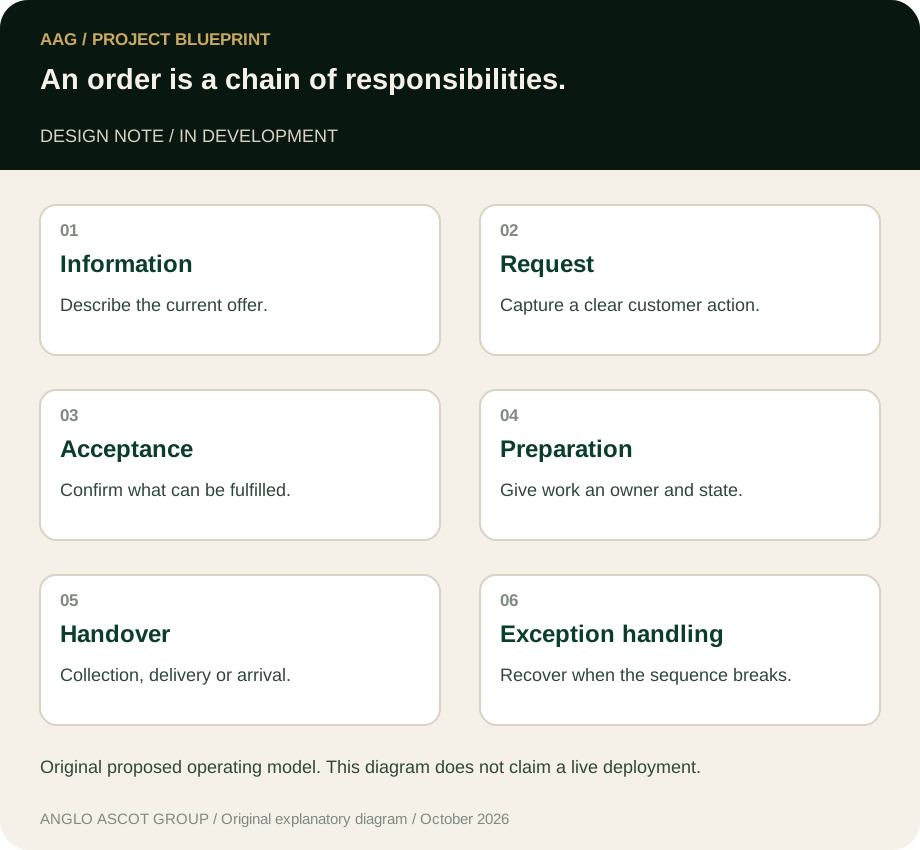
A successful button press is not the same as a successful service. A restaurant or takeaway has to receive the request, decide whether it can be fulfilled, coordinate preparation and communicate the next step. If one part of that chain has no owner, the customer-facing interface can create work that the team does not know exists.
The operating layer begins by naming those responsibilities. Public content explains the offer. A request captures the customer’s intention. An acceptance decision confirms what the business will do. The working view helps the team fulfil it. These stages may be simple, but merging them into one vague status creates avoidable ambiguity.
The pattern applies differently to bookings and orders. A booking is mainly a capacity commitment over time. An order concerns items, availability, preparation and collection or delivery. They should share information only where the actual process calls for it.
WORKING MODEL
Keep menu, service times, booking information and availability aligned with what the venue can support.
Identify who accepts requests, updates availability, handles cancellations and resolves a failed handoff.
Use a working view to answer a recurring decision, such as what is accepted and still requires action. Avoid a dashboard filled with numbers nobody can act on.
EXPLAINED VISUALLY
An original high-level blueprint. Read each step alongside the project stage and the operating decisions above.
Open the blueprintPROOF OF CONCEPT
The most revealing prototype is often an exception. Mark an item unavailable during a test order. Cancel a booking after it has reserved capacity. Interrupt a connection between the customer action and the staff view. Ask what the customer sees, what the team sees and what record remains.
Those exercises reveal where a process needs a clear source of truth. An item’s availability cannot be independently edited in several places without an agreed way to reconcile differences. A cancellation should not silently disappear from one view while remaining active in another.
A fallback process is part of the design. It should say who checks unresolved requests and how the business avoids treating an unconfirmed action as accepted. The exact steps depend on the venue and the chosen providers; this public diagram does not expose venue-specific operations.
EVIDENCE & LIMITS
A development blueprint supporting Hospitality Systems. It uses fictional examples to explain customer requests, staff responsibilities and the checks needed before a venue deployment.
THE USEFUL LESSON
Follow one request all the way to completion before adding another feature. A simple reliable chain is more useful than a crowded screen with unclear responsibility. Explore hospitality websites and systems or workflow automation.
Tell us what happens today, where the handoff breaks and who needs a clearer view.