Walk-in entry
A proposed link or QR code could record arrival, with a clear distinction between joining remotely and checking in at the shop.
 Consultancy · Systems · InfrastructureGet in touch
DESIGN NOTE / FUTURE CUSTOMER FLOW
A customer-flow design note connected with the live Turkish Barbers website in Castle Bromwich. Queue and booking functions remain in development; the ideas below explore that future scope.
THE DESIGN PROBLEM
A walk-in business already has an operating model. Customers arrive, staff judge the current demand and service proceeds within the available capacity. Adding online booking changes the promise made to a customer. Adding a digital queue changes how a place in the service order is recorded. Neither should be introduced as a decorative website feature.
A future model should first decide how much of the working day remains available for walk-ins. If a limited booking layer is useful, the business must decide where a reserved customer sits alongside people already waiting. Late arrivals, breaks and variable service duration need a clear rule.
These are operational questions rather than evidence of a launched system. The delivered Turkish Barbers website continues to provide services, prices, gallery, hours, location and contact information.
WORKING MODEL
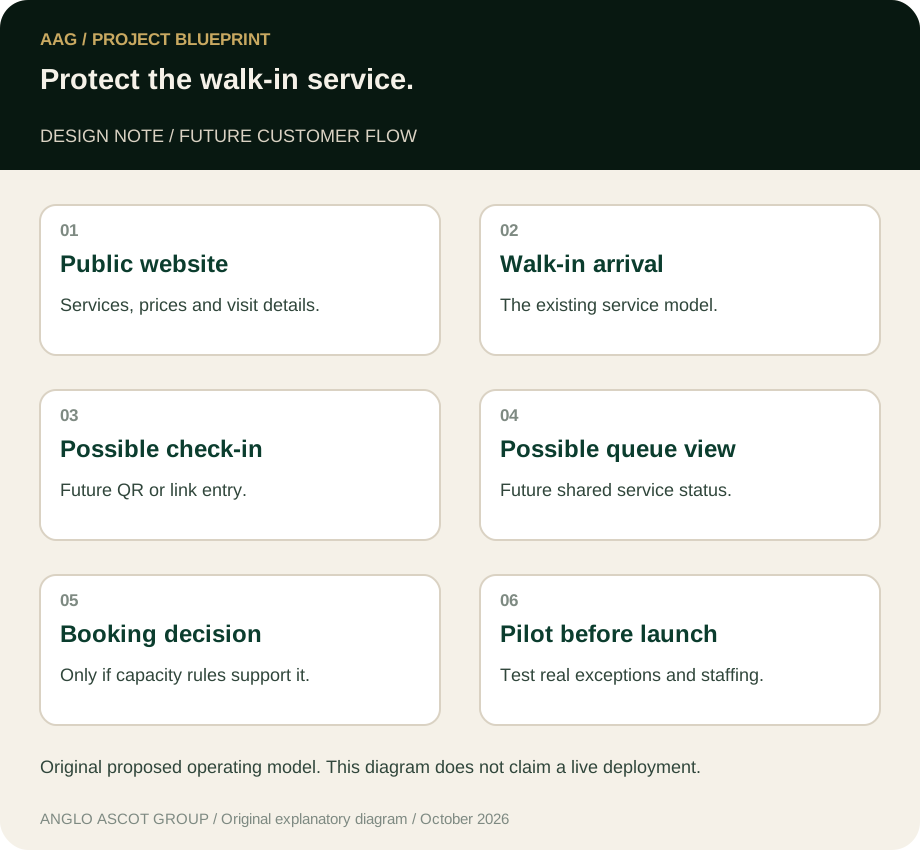
A proposed link or QR code could record arrival, with a clear distinction between joining remotely and checking in at the shop.
A customer status view and staff controls could describe the same working queue. Any estimate should be communicated honestly.
If bookings are introduced, the number and timing of reserved slots must reflect the business’s actual capacity and walk-in policy.
EXPLAINED VISUALLY
An original high-level blueprint. Read each step alongside the project stage and the operating decisions above.
Open the blueprintPROOF OF CONCEPT
The important test is whether the operating rule can be explained without the screen. A staff member should know what happens when a booked customer is late, when a walk-in has waited longer than expected and when a service takes more time than planned. If the rule is unclear, software will reproduce the uncertainty.
A prototype can use fictional customers to walk through an ordinary shift and a difficult one. Compare the staff view with the customer view at each step. Check whether an action can be corrected and whether anyone is left with an outdated promise.
The public website should communicate the actual current service, not the most ambitious future plan. Keeping coming-soon features distinct protects visitors from trying to use something that is not operational and keeps the scope of the completed project honest.
EVIDENCE & LIMITS
The public information website is live. Queue and booking functions remain in development. This illustrative blueprint explains the rules and tests a future release would need.
THE USEFUL LESSON
The service model should decide the software, not the other way around. Begin with the capacity and fairness rules, then test whether the interface makes them easier to apply. Explore Veya Cue and the customer-flow guide.
Tell us what happens today, where the handoff breaks and who needs a clearer view.