Define entry
Decide whether a link permits remote joining, on-site check-in or both. Prevent the same person from accidentally making several active entries.
 Consultancy · Systems · InfrastructureGet in touch
DESIGN NOTE / VEYA CUE EARLY BETA
A practical design note on customer check-in, staff controls and understandable waiting. It supports the Veya Cue early-beta project. The examples describe questions to resolve and test, not an already proven reduction in waiting times.
THE DESIGN PROBLEM
A queue records an order, but the business has to decide what that order means. Is someone joining remotely or confirming physical arrival? Can a customer pause their place? What happens when a person is called and does not respond? These decisions affect fairness and the working day as much as the appearance of the queue screen.
The first design task is therefore to name the states in ordinary language. A record might be waiting, being served or finished. A missed turn is a separate situation. Those examples form a proposed model to discuss with an operator, not a claim that every state has already been implemented in Veya Cue.
Customers and staff also need different information. A customer needs the relevant next action and an honest explanation of any estimate. Staff need the working controls, with enough context to correct an error. Displaying all staff information publicly would add noise and could expose personal details.
WORKING MODEL
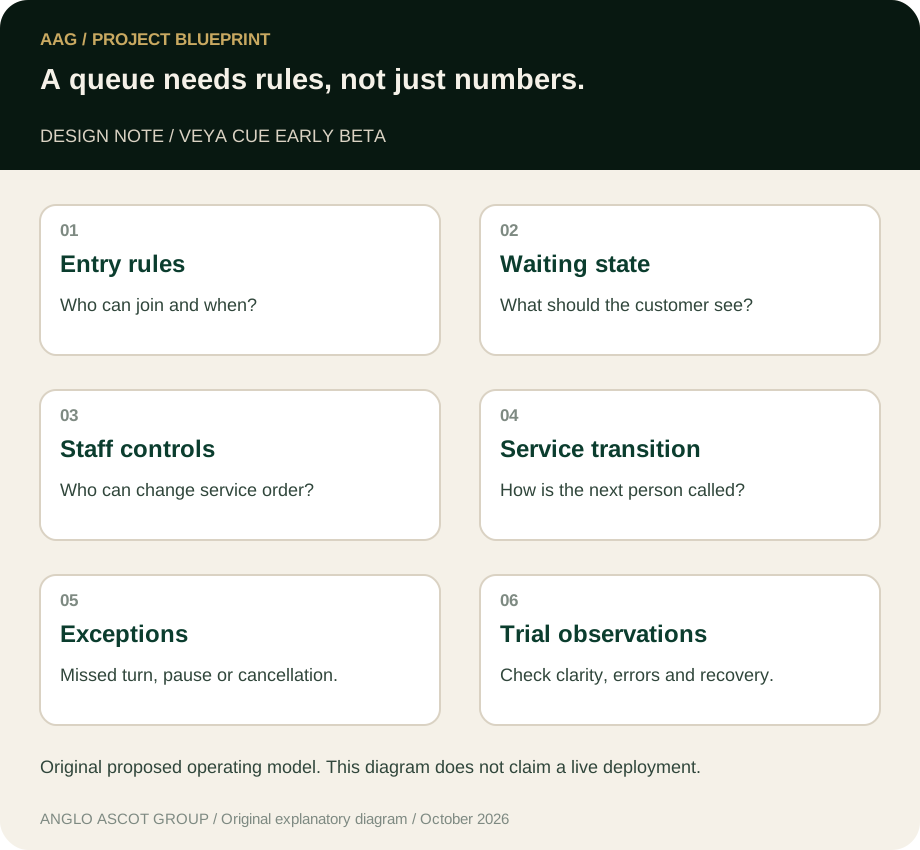
Decide whether a link permits remote joining, on-site check-in or both. Prevent the same person from accidentally making several active entries.
Write down how the next person is selected and when an operator can change that order. Make exceptions understandable to the team.
Consider a missed turn, closed queue, wrong status, customer cancellation and failed connection before the first live trial.
EXPLAINED VISUALLY
An original high-level blueprint. Read each step alongside the project stage and the operating decisions above.
Open the blueprintPROOF OF CONCEPT
A useful trial starts with a small set of representative situations. One person joins normally; another submits twice; the staff member pauses entry; someone misses a turn; a record needs correcting. The test should establish whether both views still describe the same situation.
An estimated wait needs careful wording. Service times vary, and a queue estimate is not automatically an appointment guarantee. If the business cannot support a precise promise, the product should not invent one.
The same caution applies to notifications. A notification channel has delivery, consent and operating implications. It should be agreed separately rather than assumed because a customer entered the queue. Useful software makes the actual process clearer instead of hiding missing decisions behind automation.
EVIDENCE & LIMITS
An original AAG design note supporting Veya Cue, which remains in early beta. Its blueprint is an illustrative operating model for discussion and testing.
THE USEFUL LESSON
The best queue design can be explained by the person running the floor. Start with the rules they need to apply, then make those rules understandable to customers. Compare walk-ins, queues and bookings before choosing a system.
Tell us what happens today, where the handoff breaks and who needs a clearer view.