
Sector news
New AI adoption research asks whether usage targets measure useful work
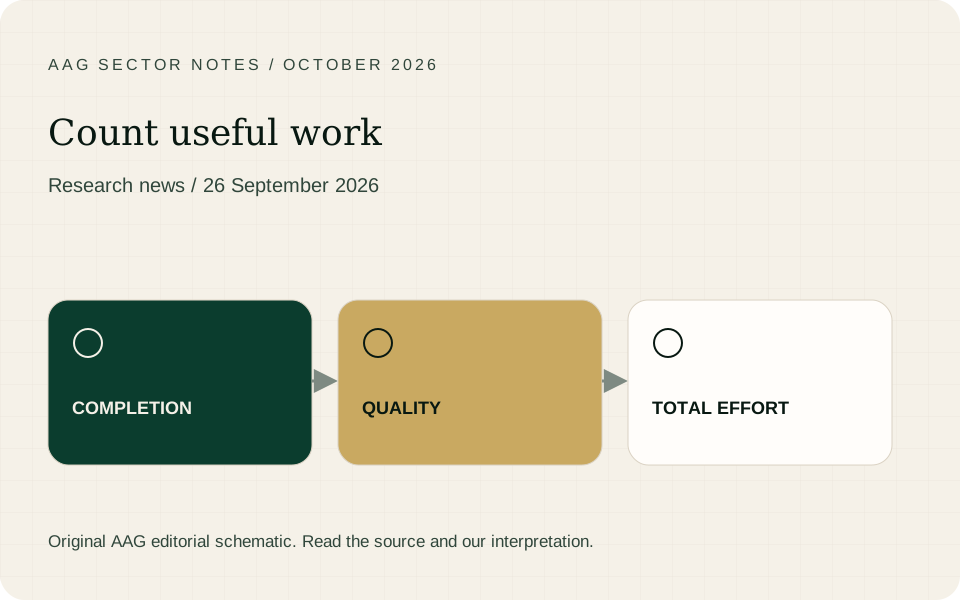
A September working paper examines AI usage targets at one company. Our reading: measure completed work and quality, not a growing prompt counter.
What happened
A working paper posted to arXiv on 26 September 2026 examines an internal AI usage mandate at a large medical-device company. The authors, Jie Gong, Jiayi Hou, Jin Li, Fei Pu and Xinjue Yao, report that reducing a monthly query target was associated with a substantial reduction in repeated or off-task use.
Read the authors' paper, When Less Is More: Managing AI Adoption with Adaptive Incentive Design. This is a preprint from one organisational setting, not a settled rule for every business or a peer-reviewed result verified by AAG. The paper's manuscript is dated 25 September; its arXiv posting is dated 26 September.
Why it matters
A busy activity chart can look reassuring while leaving the important question unanswered: did the customer, employee or business receive a better result? The distinction matters for any new tool, including a customer portal or booking process. A rising count can reflect useful activity, extra effort or repeated attempts.
AAG's take
For a small-business pilot, choose a unit of completed work before building the dashboard. An enquiry that receives an accurate, appropriate reply is a more meaningful unit than the number of times someone opens an assistant. A document request completed without repeated chasing is more meaningful than the number of notifications sent.
Keep quality and effort alongside completion. An invented trial might record whether required facts were correct, whether an employee needed to rewrite the output and how long the whole task took. The team should be able to see a failure even when the overall volume rises.
Avoid turning an experimental tool into a contest to produce the largest usage number. Give people space to identify tasks where the tool is unhelpful. A useful finding may be that a clearer form or a fixed rule is the better solution.
These suggestions are AAG's interpretation, not interventions tested by the cited paper. Our AI pilot guide includes an original evaluation worksheet and a transparent cost example.
Sources and further reading
Gong, Hou, Li, Pu and Yao, When Less Is More: Managing AI Adoption with Adaptive Incentive Design, arXiv:2609.32859v1, posted 26 September 2026. Reviewed 13 October 2026. Findings are paraphrased and should be read with the study's setting and limitations. No endorsement is implied.
KEEP EXPLORING
Another useful perspective.
Sector news · 13 Oct 2026
Shared property technology: a useful lesson from the government estate
The Government Property Agency's September case study raises a practical question for smaller operators: which systems should be shared, and which information must stay separate?
Sector news · 13 Oct 2026
NCSC's shadow AI warning: make useful tools visible
A September NCSC publication explains the risks of unapproved AI. Our practical response is a simple, usable route for staff to get help safely.
Sector news · 13 Oct 2026
NIST adds a small-business cyber support finder: make help easy to find
A new US support directory offers a useful service-design lesson for UK businesses: show people where to turn, what help covers and who owns the next step.